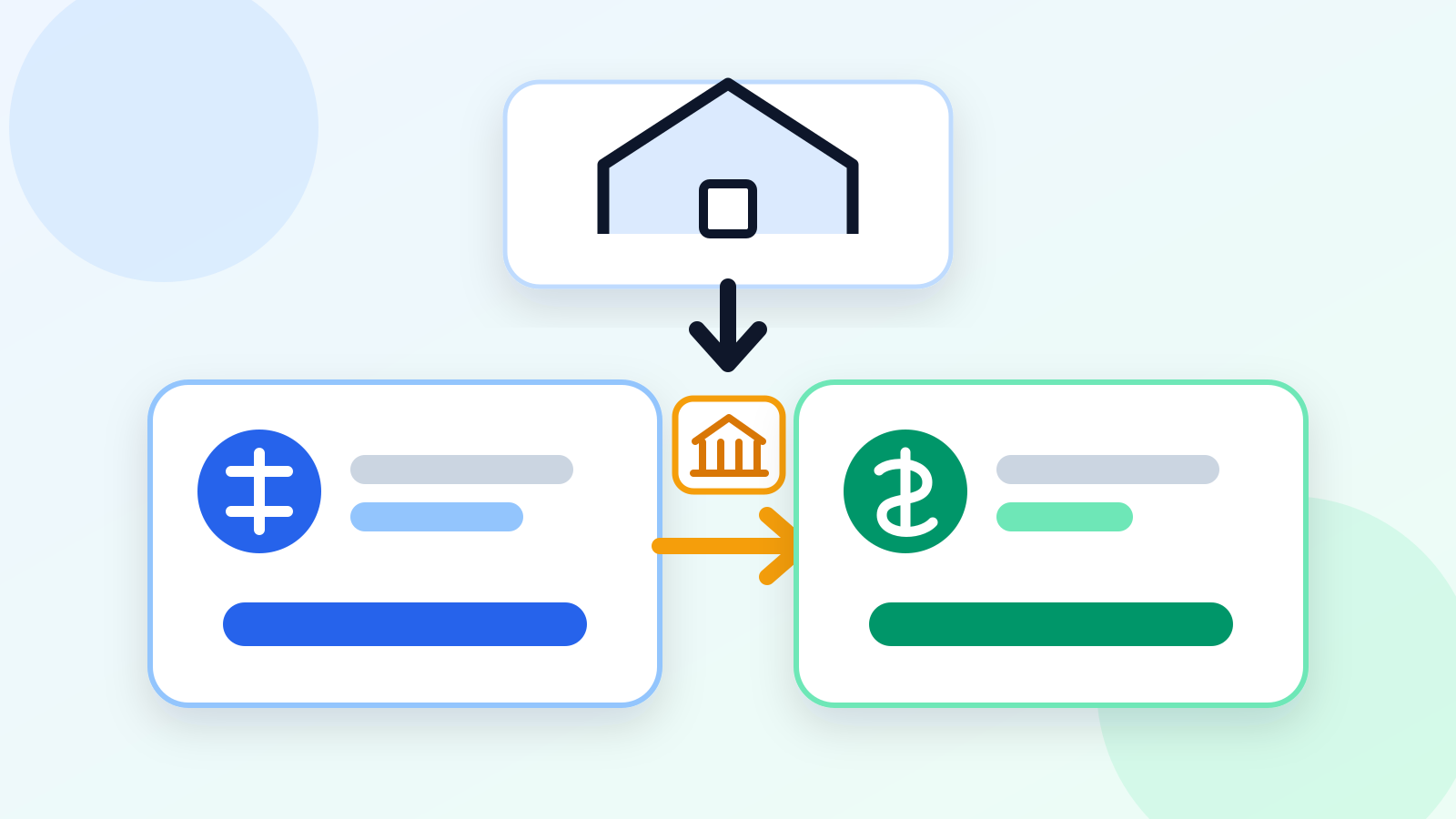
NOI vs. Cash Flow: How Financing Changes Rental Returns
Net operating income, or NOI, measures rental income after property operating expenses but before mortgage debt service. Cash flow measures the money left after both operating expenses and mortgage payments. NOI describes the property's operations; cash flow describes the financed investment's near-term cash result.
NOI and cash flow formulas
The core formulas are:
NOI = Effective Rental Income - Operating Expenses
Cash Flow = NOI - Mortgage Debt Service
Effective rental income starts with scheduled rent and accounts for vacancy or credit loss. Operating expenses include the recurring costs of running the property. Mortgage principal and interest are then subtracted from NOI to estimate cash flow.
| Comparison | NOI | Cash flow |
|---|---|---|
| Main question | How does the property operate before financing? | How much cash remains after the selected financing? |
| Formula | Effective rental income - operating expenses | NOI - mortgage debt service |
| Changes with loan amount or rate? | No | Yes |
| Includes principal and interest? | No | Yes |
| Commonly used for | Cap rate and DSCR | Monthly cash result and cash-on-cash return |
The difference in plain language
- NOI does not depend on the buyer's down payment, loan rate, or loan term.
- Cash flow changes when the financing changes.
- Mortgage principal and interest are excluded from NOI.
- The entire principal-and-interest payment reduces current cash flow.
- Principal paydown can build equity even though the payment reduces cash on hand.
- Depreciation and income tax are not part of this simple pre-tax cash flow calculation.
That makes NOI useful for comparing property operations and cash flow useful for understanding what a particular financing plan may leave each month.
What belongs in operating expenses
Operating expenses commonly include property taxes, insurance, owner-paid utilities, HOA dues, management, repairs, maintenance, local licenses, and other recurring property costs. Vacancy is generally modeled as lost income or an allowance against scheduled rent. Investors often add a capital expenditure reserve for planning even though large replacements occur irregularly.
Use the rental property operating expenses checklist before calculating NOI. For U.S. tax context, IRS Publication 527 discusses residential rental income, expenses, repairs, improvements, and depreciation. Tax classifications and a planning NOI model are related but are not identical decisions.
Worked NOI and cash flow example
Assume a rental property has $2,500 of scheduled monthly rent.
Monthly operating assumptions:
- vacancy allowance: $125
- property taxes: $300
- insurance: $150
- repairs and maintenance reserve: $125
- CapEx reserve: $125
- property management: $200
- owner-paid utilities: $75
Total estimated monthly operating expenses are $1,100.
Monthly NOI is:
$2,500 - $1,100 = $1,400
Annual NOI is:
$1,400 x 12 = $16,800
Now assume monthly principal and interest are $1,200.
Monthly cash flow is:
$1,400 - $1,200 = $200
Annual cash flow is:
$200 x 12 = $2,400
The property produces $16,800 of annual NOI in this simplified example, while this buyer's financing leaves $2,400 of estimated annual pre-tax cash flow.
How financing changes cash flow but not NOI
If the buyer makes a larger down payment, the loan amount and principal-and-interest payment may fall. NOI stays $1,400 per month because rent and property operations did not change. Cash flow rises because debt service fell.
The reverse can happen with a smaller down payment or higher rate. Identical property operations can produce lower cash flow under more expensive financing. This is why comparing advertised cap rates without also modeling the actual loan can hide an important part of the decision.
For example, compare two financing options for the same property and its $1,400 monthly NOI:
- Financing A has $1,200 of monthly debt service: $1,400 NOI - $1,200 debt service = $200 cash flow
- Financing B has $900 of monthly debt service: $1,400 NOI - $900 debt service = $500 cash flow
NOI remains $1,400 in both cases. Financing B produces $300 more monthly cash flow because its debt service is $300 lower. That does not automatically make it the better investment: achieving the lower payment may require more cash at closing, a different loan term, or other tradeoffs.
Avoid double-counting escrow
A total mortgage payment may include principal, interest, taxes, and insurance, commonly called PITI. If taxes and insurance are already inside the payment used for cash flow, subtracting them again as operating expenses double-counts them.
The Consumer Financial Protection Bureau explains PITI and how taxes and insurance may be collected through escrow. In the Rental Cash Flow Calculator, the loan inputs calculate principal and interest while taxes and insurance remain visible expense inputs.
How NOI connects to cap rate and DSCR
NOI is used in two other common property metrics:
Cap Rate = Annual NOI / Property Price or Value
DSCR = NOI / Debt Service
The exact period and conventions should remain consistent. Annual NOI should be compared with annual debt service, or monthly NOI with monthly debt service. A DSCR of 1.00 means NOI equals debt service in the simplified calculation; it does not mean the property has no other risks or cash needs.
Cash-on-cash return uses cash flow instead:
Cash-on-Cash Return = Annual Cash Flow / Cash Invested
The guide to cap rate vs. cash-on-cash return uses the same property under two financing plans to show why cap rate stays fixed while cash-on-cash return changes.
The calculator methodology documents how the public calculator defines and rounds these metrics.
When to use NOI
Use NOI when you want to:
- compare operating performance across properties
- calculate a cap rate using consistent assumptions
- estimate income available for debt service
- isolate the property from a specific buyer's financing
- evaluate whether an expense assumption is driving performance
When to use cash flow
Use cash flow when you want to:
- estimate the monthly cash left after the mortgage
- compare different down payments or loan terms
- estimate a cash-on-cash return
- understand the margin available for surprises
- plan how the property affects household or portfolio liquidity
Neither metric replaces the other. A property can have positive NOI and negative cash flow if debt service is high. It can also show positive cash flow while still carrying long-term replacement, concentration, or market risks that the monthly number does not capture.
Final takeaway
NOI answers how the property performs before financing. Cash flow answers what remains after the selected financing. Calculate and label both, keep escrow components from being counted twice, and use the same operating assumptions when comparing loan scenarios.
Run the worked example with your own numbers in the Rental Cash Flow Calculator, compare cap rate with cash-on-cash return, then read how to calculate rental property cash flow for the full step-by-step process.
Related guides
Compare cap rate and cash-on-cash return with formulas and a worked rental example showing how financing changes the return on cash invested.
Learn why rental properties have no universal average cash flow, what benchmarks are useful, and how to compare monthly cash flow with a worked example.
Use this rental property operating expenses checklist to estimate taxes, insurance, vacancy, repairs, CapEx, management, utilities, and reserves.